


Understanding the Hair Growth Cycle: Anagen, Catagen and Telogen Explained
🛍️ Shop the Mega Growth Elixir →

Every strand on your head is running its own private, months-long biological program — growing, resting, releasing, and starting again. Most of us never think about it until something changes: more hair in the shower, a routine that stops working the way it used to, or simple curiosity about why hair seems to have a mind of its own.
Understanding the hair growth cycle isn't just interesting biology — it's the foundation for making sense of almost everything else in haircare, from why results take time to why shedding fluctuates.
Why Understanding the Hair Growth Cycle Matters
Nearly every question people ask about their hair — why it's thinning, why a new routine hasn't "worked" yet, why shedding seems to come in waves — has its answer somewhere in this cycle. If you've started a new haircare routine and haven't seen a change yet, that's not necessarily a sign it isn't working — hair growth operates on a timeline measured in months, not days.
The Four Phases of Hair Growth
Each individual hair on your head moves through four distinct phases, independently of the hairs around it — which is exactly why you never lose or grow hair all at once.
- Anagen (Growth Phase) — the active growth phase, typically lasting two to seven years. Roughly 85–90% of hair is in this phase at any time, and its length is largely genetically determined.
- Catagen (Transition Phase) — a short transitional phase lasting around 10 days, during which the follicle shrinks and growth slows before stopping.
- Telogen (Resting Phase) — a resting phase lasting roughly three months, during which the fully formed hair remains anchored but isn't growing.
- Exogen (Shedding Phase) — the hair is finally released, making way for a new anagen hair. Losing 50–100 hairs a day this way is entirely normal.
| Phase | Duration | % of Hair | What's Happening |
|---|---|---|---|
| Anagen | 2–7 years | 85–90% | Active growth |
| Catagen | ~10 days | 1–2% | Follicle transitions and shrinks |
| Telogen | ~3 months | 10–15% | Hair rests, fully formed |
| Exogen | Ongoing | 50–100 hairs/day | Hair sheds, cycle restarts |
What Can Disrupt the Hair Growth Cycle
Because every hair cycles independently, the process is generally self-balancing — but hormonal changes, significant stress, nutritional gaps and scalp health can all shift the ratio of hairs in each phase, most commonly pushing more hair than usual into the resting and shedding phases at once. A disrupted cycle doesn't mean hair has stopped growing permanently — in most cases the cycle rebalances over the following months once the underlying cause resolves.
Supporting a Healthy Growth Cycle Through Scalp Care
Since every hair grows from a follicle rooted in the scalp, the environment that follicle sits in plays a role in how well the cycle functions. This is where consistent scalp care earns its place — not as a way to override the cycle, but as a way to support the conditions it depends on.

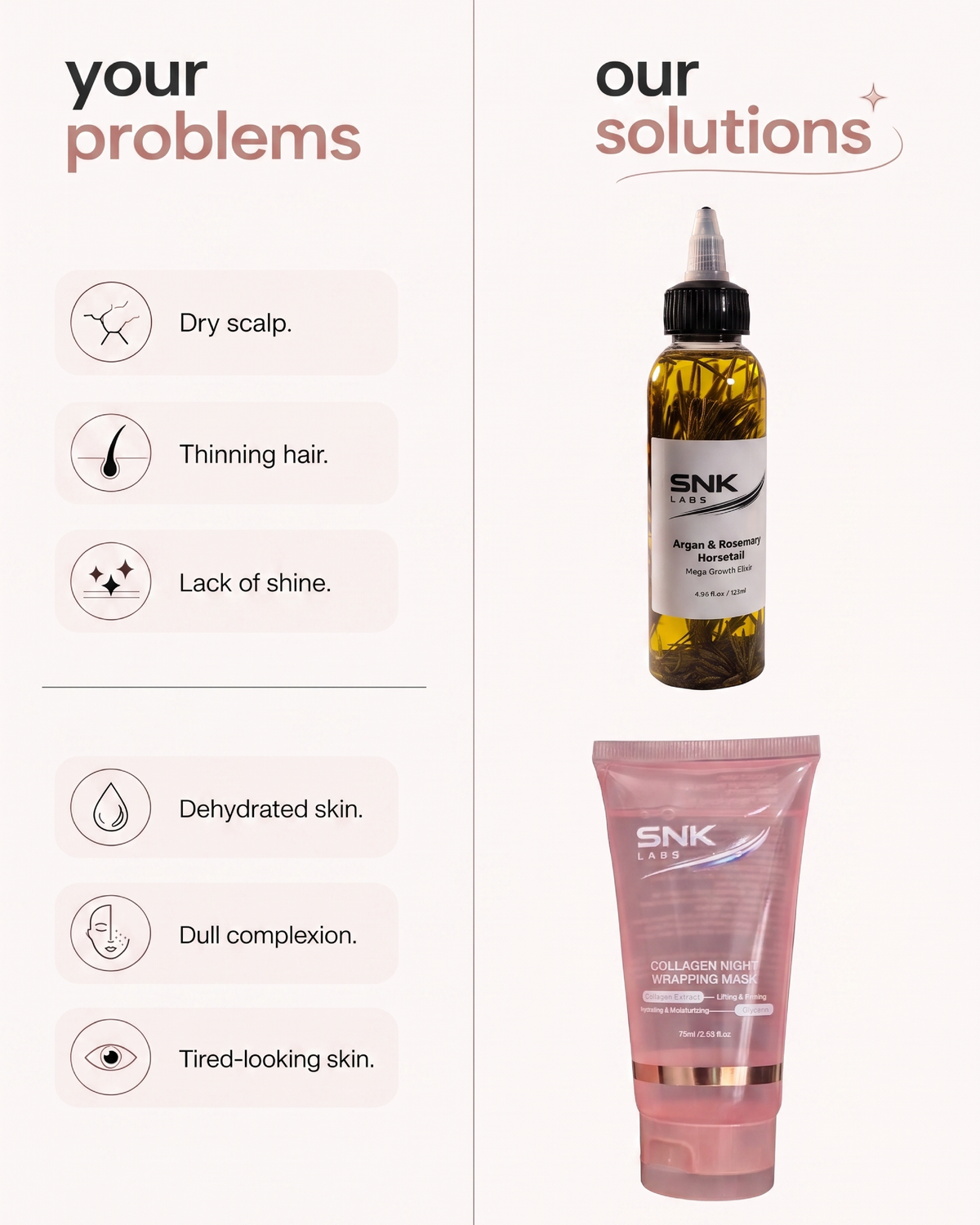
Botanical oils like rosemary oil are traditionally used to help support a healthy scalp environment — the thinking behind the SNK Labs Mega Growth Elixir, a botanical blend designed to nourish the scalp consistently, working alongside the cycle rather than trying to force it.
Common Myths About the Hair Growth Cycle
| Myth | Reality |
|---|---|
| "Cutting hair makes it grow faster" | Cutting affects the hair shaft, not the follicle. Growth rate is determined at the root. |
| "Losing hair every day means something is wrong" | Losing 50–100 hairs daily is a normal part of the exogen (shedding) phase. |
| "A product can speed up the anagen phase overnight" | The growth phase unfolds over years and is largely genetic; cosmetic products support the environment, not the timeline. |
Frequently Asked Questions
How long is a full hair growth cycle?
Typically two to seven years, primarily determined by the length of the anagen (growth) phase, which varies between individuals.
Is losing hair every day a problem?
No. Losing 50–100 hairs a day is a normal part of the exogen phase, as older resting hairs are released to make way for new growth.
Can stress really push hair out of its normal cycle?
Yes. Significant stress can trigger a larger-than-usual number of hairs to shift into the resting phase simultaneously, known as telogen effluvium, which typically shows up as increased shedding a few months later.
Does hair grow faster in summer?
Some research suggests minor seasonal variation, though the effect is generally small compared to genetics, hormones and overall health.
Can scalp care actually influence the growth cycle?
Scalp care supports the environment the cycle depends on — circulation, hydration, reduced inflammation — but it's a cosmetic, supportive role rather than a way to override the cycle's largely genetic timeline.
The Takeaway
The hair growth cycle explains almost everything that feels mysterious about hair — why it grows at the rate it does, why shedding happens, and why real change takes months rather than days. Understanding it sets realistic expectations for any routine you build.
Know the cycle. Support it consistently.
Individual results may vary. This product is intended for cosmetic use only.