


Does Collagen Cream Actually Work? An Honest Guide
🛍 Shop the Collagen Night Wrapping Mask →

No — topical collagen does not rebuild the collagen in your skin. Collagen molecules are far too large to penetrate the skin's surface layers. What it does do is act as a humectant on the surface, helping skin hold water so it looks smoother and feels softer. That's a real benefit, just a different one from the one usually advertised.
Collagen is one of the most-marketed words in skincare and one of the least-explained. It appears on creams, masks, powders, drinks and gummies, usually alongside imagery that implies something is being restored deep inside the skin.
The chemistry is less accommodating than the marketing. That doesn't make collagen skincare pointless — we sell some — but it does mean the reason it works isn't the reason most people think. Here's the honest version.
The Short Answer
Applying collagen to your skin does not increase the collagen in your skin. It cannot. The molecule is too large to get through the outer layer, and even if it could, your body doesn't take delivery of intact collagen and install it where it's needed.
What topical collagen does is sit on the surface and hold water. Well-hydrated skin looks smoother and plumper and feels more comfortable. That effect is real, visible, and worth something — it's just a hydration effect, not a structural one.
Why Collagen Molecules Can't Reach Your Skin's Collagen
Your skin's outer layer is a barrier, and a fairly effective one. Its job is keeping things out. Molecules get through based largely on size, and the threshold is small — generally in the region of 500 daltons.
Native collagen is enormous by comparison, measured in hundreds of thousands of daltons. It isn't a near miss. It's orders of magnitude too big.
Hydrolysed collagen is broken into smaller fragments, which is why you'll see it on labels. Smaller fragments behave better in a formula and hold water more effectively. But smaller pieces of collagen are not collagen — they're peptides, and they don't reassemble into the structural collagen in your dermis just because they got a little further in.
| What's often implied | What actually happens |
|---|---|
| Collagen is absorbed into the skin | It stays on the surface — the molecule is far too large to pass through |
| It replaces collagen you've lost | Your body doesn't use applied collagen as building material |
| Results build structurally over time | The effect is hydration, and it fades when you stop |
| Higher collagen content is better | The rest of the formula matters considerably more |
What Topical Collagen Genuinely Does
Three things, all of them surface-level and all of them useful.
- It holds water — collagen and its fragments are humectants, drawing moisture into the outer layers and helping skin retain it
- It forms a light film — which slows how quickly that water escapes, particularly useful overnight
- It improves how skin feels — softer, more comfortable, less tight. Not a trivial thing if your skin has been feeling tight
If that sounds modest, consider that hydration is what most people are actually noticing when they say a product is working. Skin that holds water reflects light better and looks smoother. That's most of the visible benefit in a great many skincare products, collagen or otherwise.

What Actually Supports Your Skin's Own Collagen
If the goal is your skin's own collagen rather than collagen sitting on top of it, the honest hierarchy looks like this — and the first item is not close.
- Sun protection. By a considerable distance. Ultraviolet exposure is the single largest environmental contributor to collagen breakdown. Daily sunscreen does more for the long-term appearance of your skin than any serum, and it's the one step with genuinely strong evidence behind it.
- Not smoking. Unglamorous, and it matters.
- Retinoids and vitamin C. Both have reasonable research behind them for skin appearance over months. Neither is in our range, and we'd rather say so than imply otherwise.
- Sleep, nutrition and managing stress. Diffuse, hard to quantify, and real.
Notice that a collagen cream isn't on that list. It's not that collagen creams do nothing — it's that what they do is hydrate, and hydration belongs on a different list.
So Is Collagen Skincare Worth Buying?
Often, yes — for the right reason.
A well-formulated collagen product is usually a well-formulated hydrating product. The collagen is doing humectant work alongside whatever else is in there, and the whole formula is what determines the result. If it leaves your skin comfortable and looking smoother, it's doing its job.
What you shouldn't do is pay a premium specifically for the collagen content, or choose between two products on the basis of which has more of it. That number tells you very little.
What to Look For Instead of a Collagen Claim
Read the whole formula rather than the front of the box.
- Humectants — glycerin, trehalose, hyaluronic acid, panthenol. These do the hydration work, and glycerin does it as well as anything at a fraction of the cost
- Something occlusive — humectants draw water in; you need something to stop it leaving again. This is what overnight formats are for
- Barrier support — ceramides and related lipids, if your skin runs tight or reactive
- A brand that states its limits — the most reliable signal there is
Our guide to skincare ingredients in plain English covers how to read an ingredient list properly, including the trick for working out what's present in a meaningful amount.
Why We Talk About Our Own Product This Way
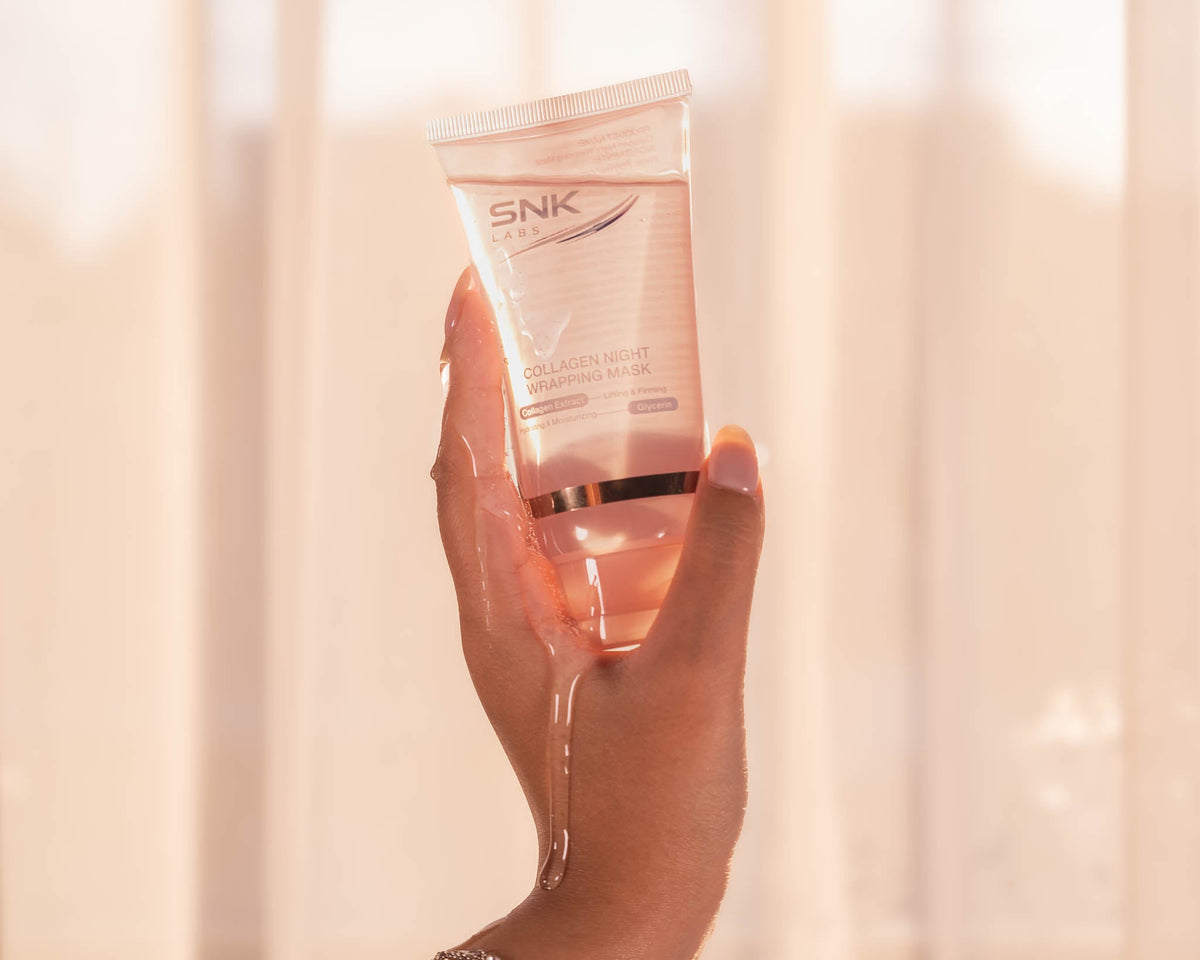
Our Collagen Night Wrapping Mask has collagen in the name. It would be straightforward to let people assume that means what they think it means.
We'd rather be accurate about it. The mask does not rebuild your skin's collagen, and we won't say that it does. What it does is hold moisture at the surface using glycerin, trehalose and soluble collagen, and form an overnight film that slows how fast that moisture escapes. You wake up with skin that feels softer and looks smoother because it's better hydrated than when you went to bed.
That's a smaller promise than the category usually makes. It's also one we can stand behind, and we think the trade is worth it — partly because a customer who knows what to expect is a customer who isn't disappointed.
Frequently Asked Questions
Can collagen be absorbed through the skin?
Not in any meaningful sense. The molecule is far larger than the skin's outer barrier allows through — by orders of magnitude, not a narrow margin. Hydrolysed collagen is smaller and behaves better in a formula, but smaller collagen fragments are peptides and don't reassemble into your skin's own collagen.
Is drinking collagen better than applying it?
It's a different question with more mixed evidence. Ingested collagen is digested into amino acids, which your body may use anywhere it likes. Some studies suggest modest effects on skin appearance; others don't. If you're curious, that's a conversation worth having with a GP or dietitian rather than a skincare brand.
What's the difference between collagen and hydrolysed collagen?
Hydrolysed collagen has been broken into smaller fragments. This makes it easier to formulate with and better at binding water, which is why most skincare uses it. It does not make it able to rebuild the collagen in your skin — that's a limitation of biology, not molecule size alone.
Does the Collagen Night Wrapping Mask rebuild collagen?
No. No topical product does. It hydrates the surface of the skin and forms an overnight film that slows moisture loss, which is why skin looks smoother and feels softer in the morning. That's the honest description of what it does.
What actually helps skin look firmer?
In the short term, hydration — well-hydrated skin looks plumper and smoother, and that's most of what people are seeing. Over years, daily sun protection does more than anything else. Anyone offering a product that changes skin structure from the outside is describing something that doesn't happen.
The Takeaway
Collagen cream doesn't rebuild collagen. It hydrates, and hydration makes skin look and feel better — which is a genuine reason to use one, just not the reason on the packaging.
Buy collagen skincare because the formula is good and your skin likes it. Don't buy it because you believe it's replacing something. And if long-term skin appearance is what you care about, put your money into sunscreen first.
Our Collagen Night Wrapping Mask does the surface job well — humectants to draw water in, an overnight film to keep it there. You can see it alongside the rest of our skincare range.
Smaller promises. Better skin.
Individual results may vary. This product is intended for cosmetic use only.