


Hair Breakage: Why It Happens and How to Reduce It
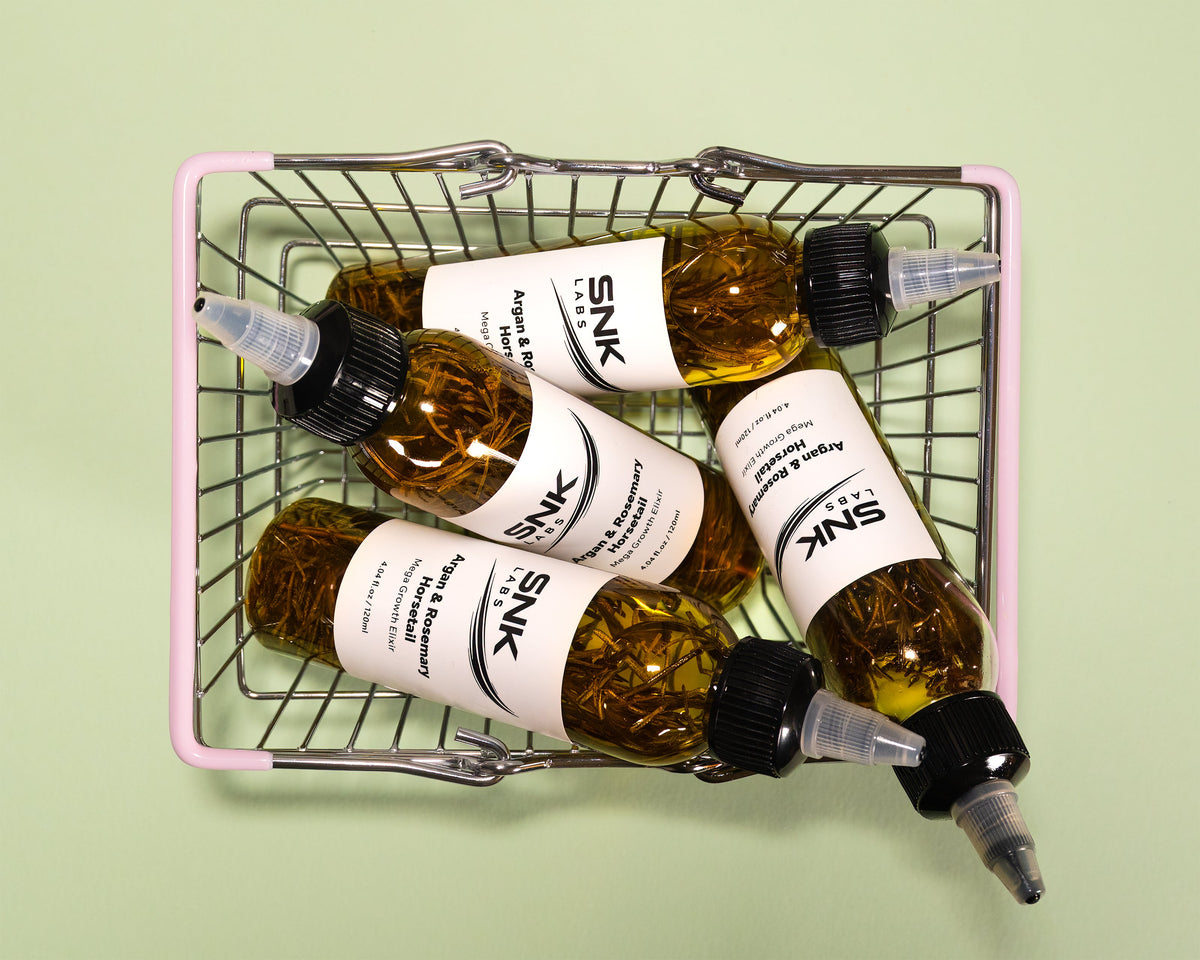
🛍 Shop the SNK Labs Hair Growth Elixir →

Most hair that seems to have stopped growing hasn't — it's breaking off at roughly the same rate it grows. Breakage happens when the outer layer of the hair is worn down by heat, friction, chemical processing and dryness, leaving strands brittle enough to snap. It's largely preventable, and it's the most common reason people can't get past a certain length.
There's a particular frustration in feeling like your hair has hit a ceiling. You've been growing it for months, and it just sits there — same length, more split ends, thinner-looking through the bottom third.
The usual conclusion is that your hair has stopped growing. Almost always, it hasn't. It's growing at the same rate it always did, and losing the same length off the bottom. Here's why that happens, and what actually reduces it.
Breakage Is Not the Same as Shedding
These get confused constantly, and the difference matters because the solutions are completely different.
Shedding is a whole hair leaving the scalp, root and all. It's normal — most people lose somewhere between 50 and 100 hairs a day as part of the natural cycle. A shed hair has a small white or pale bulb at one end.
Breakage is a strand snapping partway along its length. No bulb, just a broken end. These are usually shorter than your full length, and you'll find them on your clothes, in your brush and across the bathroom floor.
If what you're seeing is short broken pieces rather than full-length hairs with bulbs, this article is the relevant one. If you're seeing lots of full-length hairs with bulbs, or noticing patches or a widening part, that's a different question — and one for a GP or dermatologist rather than a product.
Our guide to the hair growth cycle covers the shedding side properly, including why it fluctuates seasonally.
What Actually Causes Breakage
Hair is a structure of keratin protected by an outer layer called the cuticle — overlapping scales that lie flat when hair is healthy. When those scales lift or wear away, the inner structure is exposed, moisture escapes, and the strand loses flexibility. Inflexible hair snaps.
The main culprits, roughly in order of how much damage they do:
| Cause | What it does | How fixable |
|---|---|---|
| Chemical processing | Bleach and relaxers permanently alter the hair's structure | Not reversible — manage and grow out |
| Heat styling | High temperatures drive out moisture and lift the cuticle | Very fixable — lower the temperature |
| Mechanical stress | Brushing wet hair, tight ties, rough towel-drying | Very fixable — mostly habit |
| Dryness | Dry hair is inflexible, and inflexible hair snaps | Very fixable — conditioning helps directly |
| Sun, salt and chlorine | Degrade the cuticle over repeated exposure | Manageable with rinsing and cover |
Wet hair is the one most people underestimate. Hair absorbs water and swells, which makes it considerably more elastic and more fragile than dry hair. Brushing it hard, tying it up tightly, or rubbing it with a towel while wet does more damage than almost anything else on that list — and it's completely free to stop.

Eight Changes That Actually Reduce Breakage
Ranked by how much difference they make relative to effort. The first four cost nothing.
- Stop brushing hair while it's soaking wet. Let it dry to damp first, then work from the ends upward with a wide-tooth comb. Starting at the roots drags every tangle down the length of the hair.
- Turn your heat tools down. Most straighteners run far hotter than anyone needs. Lower settings take slightly longer and cost you dramatically less length over a year.
- Loosen your hair ties, and never tie hair up wet. Tight elastics create a stress point in exactly the same spot every day. That's where hair snaps.
- Stop rubbing your hair with a towel. Squeeze the water out instead. A cotton t-shirt or microfibre towel causes less friction than terry cloth.
- Condition the mid-lengths and ends every wash. This is the oldest advice in haircare and it remains the most effective. Conditioned hair is flexible hair.
- Use a weekly oil treatment. A lightweight oil helps reduce the appearance of dryness and breakage by conditioning the strand so it flexes rather than snaps. Overnight, washed out in the morning — our at-home head spa guide sets out a simple routine.
- Get a trim every 8 to 12 weeks. Counterintuitive when you're growing your hair, but a split travels upward. Removing half a centimetre now saves several later.
- Protect from sun, salt and chlorine. Rinse with fresh water before swimming so the hair absorbs less pool or sea water, and wear a hat when you're out for long stretches.
What Won't Fix It
Being straight about this, because the category isn't.
Split ends cannot be repaired. Once a strand splits, the only permanent fix is cutting it off. Products described as repairing or sealing split ends are temporarily binding the strand together — useful cosmetically, and it washes out.
No product reverses chemical damage. Bleaching permanently alters the hair's internal structure. You can condition it, protect it and grow it out, but you can't undo it.
And no oil, mask or treatment makes hair grow faster. Growth rate is set by genetics and biology — roughly a centimetre a month for most people. What you can change is how much of that growth you keep, which is the whole point of reducing breakage.
How Long Before You Notice
Faster than most things in haircare, which is unusual and encouraging.
- Immediately — fewer broken pieces in your brush once you change how you handle wet hair
- Four to six weeks — less snapping during brushing and styling, and ends that look less frayed
- Six months and beyond — this is when length starts to show, because you're finally keeping what you grow
Breakage is the rare haircare problem where the fixes are mostly free and the results arrive reasonably quickly. Most of the eight changes above are habits rather than purchases.
Frequently Asked Questions
How do I tell breakage from hair loss?
Look at the end of the hair. A shed hair has a small white or pale bulb at the root end and is usually your full length. A broken hair has no bulb and is shorter than your overall length. Lots of short pieces without bulbs points to breakage rather than shedding.
Can split ends be repaired?
No. Once a strand has split, cutting is the only permanent solution. Products that claim to seal or mend split ends are temporarily binding the strand back together, which improves how it looks and feels until the next wash. That's genuinely useful — just not a repair.
Does trimming make hair grow faster?
No — growth happens at the scalp and trimming the ends has no effect on it. What trimming does is stop splits travelling further up the strand, so you lose less length over time. The hair grows at the same rate; you simply keep more of it.
Will an oil treatment stop breakage?
It helps by conditioning the strand so it stays flexible, and flexible hair snaps less. But an oil won't compensate for daily high-heat styling or brushing soaking-wet hair. Think of it as one part of the routine rather than the whole solution.
Why does my hair seem to stop at a certain length?
Usually because breakage at the ends has caught up with growth at the roots — you're losing length as fast as you're gaining it. Reduce the breakage and the same growth rate starts showing as extra length. Occasionally it reflects a naturally shorter growth phase, which is genetic.
The Takeaway
If your hair feels stuck, it's probably not a growth problem. It's a retention problem — and retention is far more within your control than growth rate ever will be.
Handle wet hair gently, turn the heat down, loosen the ties, condition properly, and oil the lengths once a week. None of that is complicated, and most of it is free.
The SNK Labs Hair Growth Elixir is a lightweight blend of grape seed and camellia seed oils that conditions without weighing hair down. For more on choosing and using one, see our Australian guide to hair growth oils, or browse our haircare range.
Grow it. Then keep it.
Individual results may vary. This product is intended for cosmetic use only.