


Rosemary Oil for Hair: What the Research Actually Says
🛍 Shop the SNK Labs Hair Growth Elixir →

Rosemary oil is one of the more-studied botanical ingredients in haircare, valued for supporting a healthy scalp environment and for its conditioning properties. Research is promising but mostly small-scale, and it is a cosmetic ingredient rather than a treatment for hair-loss conditions.
Rosemary has had an unusual few years. It went from a herb in the kitchen to the most talked-about ingredient in haircare, largely through social media, and it now appears in a very large number of formulations — ours among them.
Some of that attention is deserved. Some of it has drifted well past what the evidence supports. This article is an attempt to draw that line honestly: what rosemary oil is, what research exists, what hasn't been established, and how to actually use it.
What Rosemary Oil Is
Rosemary oil is an essential oil steam-distilled from the leaves of Rosmarinus officinalis — the same plant you'd cook with. It's a concentrated aromatic extract, not a carrier oil, and that distinction matters for how it's used.
Its main constituents include cineole, camphor and pinene, along with antioxidant compounds. In haircare it appears in two forms: rosemary essential oil, and rosemary leaf extract. Both are typically present in small percentages within a base of carrier oils, which is where the bulk of a formula's conditioning actually comes from.
Rosemary oil is never meant to be used undiluted. More on that below, because it's the part people most often get wrong.
What the Research Actually Supports
Rosemary oil is among the more-studied botanical ingredients in haircare, and existing research is promising enough to explain why it appears in so many formulations — though most of it is small-scale and cosmetic outcomes vary between individuals.
Where the evidence is reasonable:
- Antioxidant activity — well established in laboratory work, and part of why it's a useful addition to an oil blend
- Supporting a healthy scalp environment — the property most consistently attributed to it, and the one we describe it by
- Conditioning and sensory qualities — it contributes to how a formula feels and smells, which affects whether people keep using it
And what hasn't been established, stated plainly:
- That it treats hair-loss conditions. It doesn't, and it isn't a therapeutic product
- That results are predictable between individuals. They aren't. Hair responds to genetics, hormones and health far more than to any topical ingredient
- That any particular concentration produces a particular outcome. There's no agreed dose in cosmetic use
The honest summary: the research is interesting and incomplete. Interesting enough to justify rosemary's place in a formulation. Incomplete enough that anyone quoting it as proof of regrowth is going beyond what the studies can carry.
What It Won't Do
Rosemary oil is a cosmetic ingredient. It will not regrow hair, will not reverse or stop hair loss, and will not change the density you were born with. Those outcomes sit with genetics, hormones and medical conditions — none of which a botanical oil influences.
If you're seeing sudden shedding, patchy loss, or a change in your hairline that's worrying you, that's a conversation for a GP or dermatologist. There are real medical options and they're worth knowing about. Using a cosmetic oil in place of getting advice mostly costs you time.
What rosemary oil, in a well-made blend, can reasonably do: help the scalp feel comfortable and cared for, contribute to hair that looks healthier and shinier, and make a weekly routine something you actually want to do.

How to Use Rosemary Oil on Your Scalp
Never apply undiluted rosemary essential oil directly to your scalp. This is the most important line in the article. Undiluted essential oils can cause irritation, sensitisation and contact dermatitis. Rosemary essential oil needs to be diluted in a carrier oil — generally to somewhere around 1–2% — or used in a product that has already done that for you.
Assuming you're using a properly formulated blend rather than neat essential oil:
- Apply to dry hair, on the scalp. Part your hair in sections and apply along each parting. Five to eight drops for shorter hair, ten to fifteen for longer. Oil and water don't mix, so damp hair means the oil sits on the surface instead of reaching the skin.
- Massage for three to five minutes. Fingertips, not nails, small slow circles. This distributes the oil evenly and is most of the benefit — our guide to scalp massage technique covers it properly.
- Choose overnight or pre-wash. Overnight gives the longest contact time and is what we'd suggest. A pre-wash treatment of thirty to sixty minutes works if overnight doesn't suit — anything under fifteen minutes is largely decorative.
- Once or twice a week. More often doesn't accelerate anything. It just means more washing.
- Shampoo before adding water. Apply shampoo straight onto the oiled hair, work it through, then rinse. This is the difference between one wash and three.
What to Look For in a Rosemary Hair Oil
The word rosemary on the front tells you very little. What matters is the rest of the bottle.
- Lightweight carrier oils — grape seed and camellia seed absorb readily and wash out in one go. Heavier bases like coconut and castor suit some people and put others off oiling permanently
- Sensible dilution — a formula built around carriers with essential oils in the minority, not the reverse
- Where rosemary sits on the ingredient list — if it appears below the preservative, it's present in trace amounts regardless of what the label says
- Realistic claims — a brand promising regrowth is telling you something it can't know
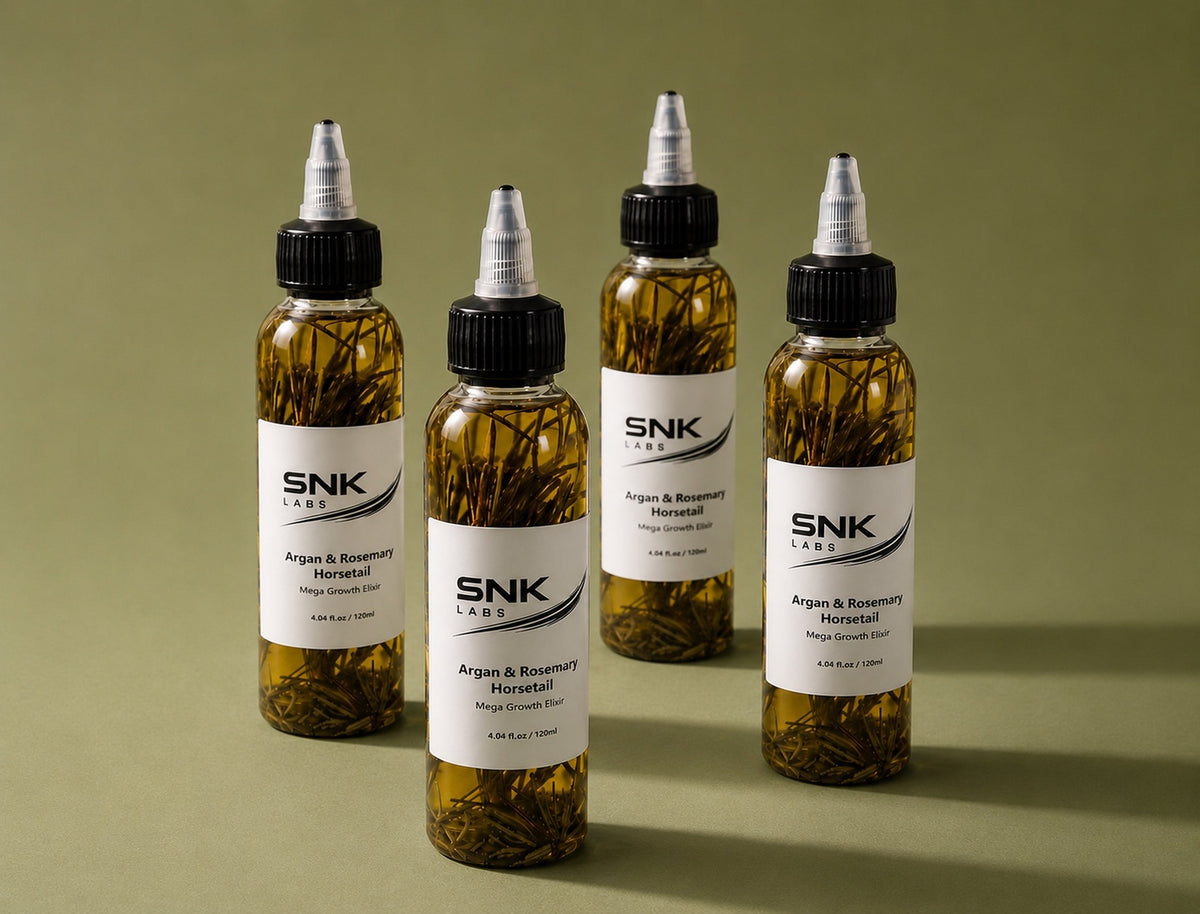
For what it's worth, our own Hair Growth Elixir is built on grape seed and camellia seed oils, with rosemary, ginger, rice germ and turmeric through the middle and vitamin E to keep the blend stable. Rosemary is one component of a blend, which is how we'd suggest thinking about it generally.
How Long Before You'd Notice Anything
Longer than the videos suggest.
- First few uses — softer hair, more shine, a scalp that feels better. Surface effects, and immediate
- Four to six weeks — less breakage while brushing and styling, with consistent use
- Three months and beyond — the realistic horizon for anything cumulative, set by the growth cycle rather than the product
Our guide to the hair growth cycle explains why those timelines are what they are. The short version: hair grows on a schedule measured in years, and nothing applied to the outside changes that schedule.
Frequently Asked Questions
Can I put rosemary oil directly on my scalp?
Not undiluted essential oil — it can cause irritation and sensitisation. Dilute it in a carrier oil, generally to around 1–2%, or use a product that's already formulated for scalp use. A pre-blended oil takes the guesswork out and is the safer option for most people.
How often should I use it?
Once or twice a week suits most people. Twice if your scalp runs dry, once if it runs oily. There's no benefit to daily use, and over-application mostly creates more washing rather than better results.
Does rosemary oil work for everyone?
No. Cosmetic outcomes vary considerably between individuals, because hair is governed largely by genetics, hormones and overall health. Some people notice a difference in how their scalp feels and how their hair looks; others notice very little. Any brand claiming otherwise is overstating what's knowable.
Can I leave it on overnight?
Yes, and overnight is what we'd suggest — it gives the longest contact time with the scalp. Use an older pillowcase or wrap your hair in a towel, then shampoo it out in the morning, applying shampoo before water.
Is rosemary oil safe during pregnancy?
Please speak with your GP, midwife or another healthcare professional before using essential oils during pregnancy or while breastfeeding. Advice varies with circumstances and it isn't something we're able to give you. We'd rather point you to someone qualified than guess.
The Takeaway
Rosemary oil earned its place in haircare, and then the internet oversold it. Both things are true.
It's a well-regarded botanical with genuine antioxidant properties and a long history of use for scalp care, supported by research that's promising and not yet conclusive. It's a cosmetic ingredient in a blend — not a treatment, not a shortcut, and not a substitute for medical advice when something is genuinely wrong.
Diluted properly, massaged in, used weekly and given three months, it's a pleasant and worthwhile part of looking after your scalp. That's the honest case for it, and we think it's enough.
For more on choosing and using an oil, see our Australian guide to hair growth oils, or browse the rest of our haircare range.
Dilute properly. Use consistently. Expect honestly.
Individual results may vary. This product is intended for cosmetic use only.